A recent open-source flight observation may reveal something larger than a single aircraft movement. On 27 April, a U.S. Navy CMV-22B Osprey reportedly departed Djibouti under the callsign STMPD42. The aircraft was not continuously visible on public tracking platforms, but a later transponder signal was reportedly received in the Gulf of Oman, an area where the USS Abraham Lincoln is believed to be operating near Iranian waters.
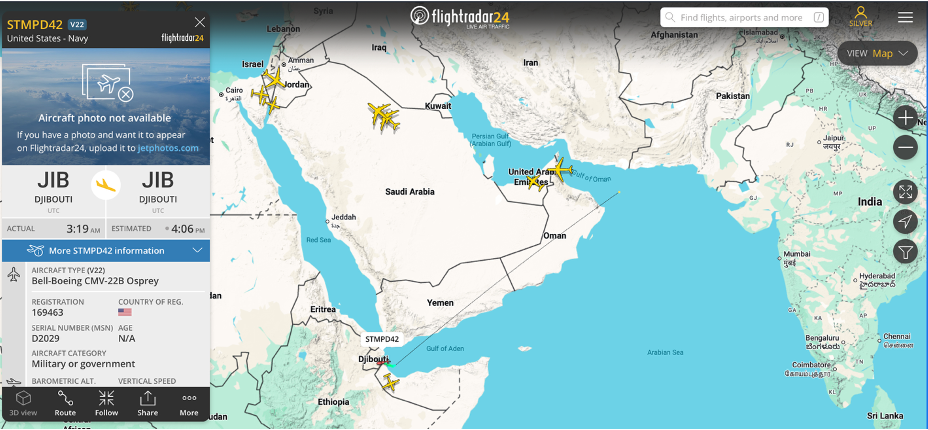
At first glance, this may look like a routine logistics flight. But the aircraft type, the route, and the regional context make it more significant. The CMV-22B is not a normal transport aircraft. It is the U.S. Navy’s carrier logistics platform, used to move personnel, equipment, mail, and critical supplies between land bases and aircraft carriers at sea. If a CMV-22B moved from Djibouti toward the Gulf of Oman, one plausible explanation is support for a U.S. carrier strike group.
The strongest candidate would be the USS Abraham Lincoln. Some may ask why the aircraft could not be supporting USS Tripoli, which can also operate Osprey-type aircraft. The answer is that the CMV-22B is specifically associated with carrier onboard delivery. Tripoli, as an amphibious assault ship, is more naturally linked to Marine Corps MV-22 operations, while the CMV-22B is designed around aircraft carrier logistics. Therefore, if STMPD42 was moving toward the Gulf of Oman, a connection to Lincoln appears more plausible.
This matters because the Abraham Lincoln’s reported presence near the Gulf of Oman comes at a sensitive moment. U.S. naval forces are operating close to Iran’s maritime approaches, while pressure on Iranian shipping and regional deterrence operations has increased. In this environment, even a logistics movement can become part of a larger military picture. Aircraft carriers are not only symbols of power; they are floating airbases that require constant resupply. Without a reliable supply chain, their operational endurance is limited.
This is where Djibouti becomes important.
For years, Djibouti has been known mainly as the location of Camp Lemonnier, the key U.S. base in the Horn of Africa. Traditionally, it has been viewed through the lens of counterterrorism, East Africa, Yemen, and Red Sea security. But recent movements suggest that Djibouti may now be playing a wider role: not just as an African base, but as a rear support point for U.S. operations across the Red Sea, Arabian Sea, and Gulf of Oman.
Geographically, the logic is clear. Djibouti sits near the Bab el-Mandeb Strait, one of the most important maritime chokepoints in the world. From there, U.S. aircraft and naval support routes can connect the Red Sea to the Arabian Sea and onward toward the Gulf of Oman. It is close enough to support operations around Iran, but not as exposed as bases inside the Persian Gulf.
That distance may be the real strategic advantage.
U.S. bases in Qatar, Bahrain, the UAE, Kuwait, Saudi Arabia, and Oman are much closer to Iran. In a direct confrontation, they would be more exposed to Iranian missiles, drones, proxy attacks, and political pressure. Djibouti, by contrast, offers strategic depth. It is farther from Iran’s immediate strike geography, making it a more robust location for maintenance, personnel movement, and rear-area support.
This does not mean Gulf bases are no longer important. They remain central to the U.S. military posture in the Middle East. But they also come with constraints. Qatar hosts major U.S. military infrastructure, yet Doha has strong reasons to avoid being seen as a direct launchpad for attacks on Iran. Oman has an even more delicate position. Muscat has often played a mediating role between Iran and the West, and it has historically tried to avoid direct alignment in confrontations with Tehran.
In other words, even when Gulf states cooperate with Washington, they may not want their territory to become visibly connected to military operations against Iran. This creates a need for alternative nodes that are politically less sensitive and militarily less vulnerable. Djibouti fits that role well.
This is the key point: the U.S. military posture around Iran is not only about where the aircraft carriers are. It is also about where the support network is being built.
A carrier near Iran needs spare parts, personnel transfers, aviation components, and continuous supply routes. The visible carrier is only the front end of the system. Behind it is an architecture stretching across bases, ports, airfields, and partner countries. Djibouti appears to be gaining importance inside that architecture.
The reported STMPD42 flight should therefore be read carefully. It does not prove, by itself, that Djibouti has officially become a new CENTCOM command hub. Camp Lemonnier is still formally associated with U.S. operations in Africa. Public flight data also cannot confirm classified mission details. But logistics movements often reveal strategic adaptation before governments announce it openly.
What we may be seeing is a quiet shift: Djibouti is becoming a safer and more flexible rear base for U.S. naval operations connected to the Iran theater.
Its value is not only that it is near the Red Sea. Its value is that it is near enough to support the mission, but far enough to survive the first shock of escalation. Compared with GCC bases, Djibouti is less exposed to Iranian retaliation and less politically constrained by Gulf diplomacy. That makes it attractive for Washington at a time when operations near Iran require both reach and resilience.
If the Abraham Lincoln is indeed being supported through Djibouti, then this is more than a technical logistics detail. It suggests that the United States may be adapting its regional posture by spreading support functions away from the most vulnerable Gulf locations. In a crisis, this kind of distribution can be decisive.
Djibouti may not be the center of attention, but it may be becoming one of the quiet pillars of U.S. military power projection around Iran. The aircraft carriers draw the headlines. The support hubs decide how long they can stay there.