It has now been around 18 hours since the announcement of a two-week ceasefire between Iran and the U.S., with Israel accepting the arrangement, and with talks expected to begin on Friday in Islamabad.[1][2] One of the practical expectations around this ceasefire was that the U.S. and Israel would pause their campaign against Iran, while Iran would halt its defensive response and allow passage through the Strait of Hormuz.[1][2]
But in the hours after the announcement, the picture became much less straightforward. While Trump presented the deal as if passage through Hormuz would resume, reporting from both international media and Iranian sources suggests something different: not free passage, but limited and controlled passage.[2][3] Reuters reported that Iran was considering a controlled reopening in which ships would still need to coordinate with the Iranian military.[3] Fars News went further and described the arrangement as one under which Iran would allow only 10 to 15 ships per day, not free passage, with movement managed under Iranian control. That distinction matters: controlled passage is not an open strait.
Open-source shipping data from the first 18 hours also points in the same direction.
Based on MarineTraffic data, five non-Iranian ships attempted to pass Hormuz in that period: Daytona Beach, NJ Earth, Hai Long, New Ambition, and Iolcos Destiny. While some reports refer to the first passages after the ceasefire, the details matter more than the headline.
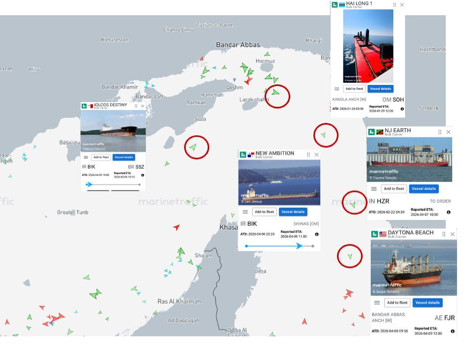
Open-source vessel traffic data for the Strait of Hormuz from MarineTraffic.com
From these five ships, Daytona Beach, Iolcos Destiny, New Ambition, and Hai Long appear to have departed from Iranian ports, including Imam Khomeini and Bandar Abbas. Since Iranian and Iran-related ships were already able to move through the strait during the war, such movements cannot be treated as evidence that Iran has reopened Hormuz as a goodwill measure. They may simply reflect the continuation of a passage pattern that already existed for Iran-linked shipping.
The case of NJ Earth is less clear, but its route over the last 24 hours appears to show movement along the Iranian coastline, from near Kish Island toward the Strait of Hormuz. That also suggests that this voyage may have been tied to Iranian-controlled routing or Iranian-linked cargo, rather than representing ordinary international transit.
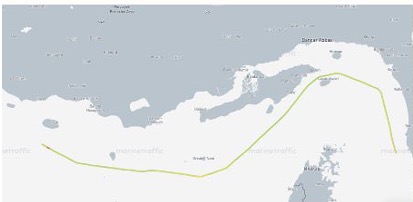
NJ Earth’s passage route over the last 24 hours
There is also another important point: today’s number is not unusual enough to prove reopening. Based on your review of recent open-source tracking, passage through the strait over the last month has already been fluctuating at roughly 5 to 10 ships per day, so what is being seen today is not fundamentally different from what was already happening before this ceasefire announcement. In that sense, today’s traffic does not show a new reality; it looks more like a continuation of the same limited pattern.

There is also a second dispute around the ceasefire itself. Pakistan’s mediation language suggested a broader de-escalation that included Lebanon, while Israel publicly said that Lebanon was not part of the deal and continued strikes there after the ceasefire announcement.[1][4][5] This matters because if Iran sees continued Israeli action in Lebanon as a breach of the ceasefire framework, then it has one more reason to avoid treating Hormuz as genuinely reopened.[1][4]
Another important point is the type of ships involved. So far, these observed passages are bulk carriers, not tankers.That matters because if Hormuz were truly reopening, one of the clearest signs would be the return of broader commercial tanker traffic. Reuters reports that only a few vessels have resumed movement with Iranian permission, while major shipping firms remain cautious.[3]
So at this stage, the conclusion remains simple:
The Strait of Hormuz is still not open.